

PBOC Flags ‘New Normal’ of Slower M2 Growth

(Beijing) — This might be another sign that shows China has made progress in cutting leverage in its bloated financial system.
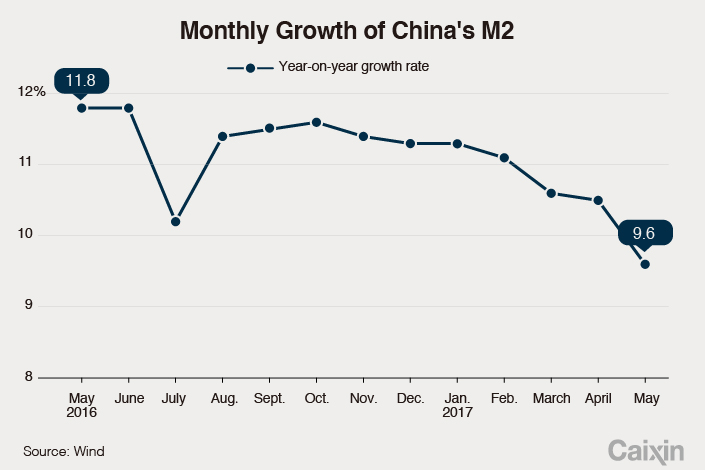
On Wednesday, the People’s Bank of China said the country’s broader money supply, or M2, grew at a record-low pace of 9.6% in May from a year ago. The metric was hovering above 10.5% for most of the past year.
M2 refers to cash and checking deposits — the so-called M1 — plus assets such as money market securities and mutual funds that can be converted quickly into cash.
Going forward, a relatively subdued growth of China’s M2 is set to be a “new normal,” the central bank added.
Or is it?
Regulators in China have been trying to mop up the excesses within the financial system, which is sitting on a massive debt pile — as well as default risks — after years of credit-fueled economic growth.
In May, new credit — including vanilla bank loans, bond and equity issuance, and trust and entrusted loans — also shrank to 1.06 trillion yuan ($156 billion) from 1.39 trillion yuan in April. May was the second consecutive month of decline.
“Under a prudent and neutral monetary policy and tighter regulations, financial institutions have adjusted their businesses, and leverage has been trimmed,” the central bank said Wednesday.
Since March, banking regulators have been rolling out sweeping regulations to unwind a steroid-infused system and to keep systemic risks from ballooning further. Measures include a tighter oversight of high-yield wealth management products that banks sell to each other, a practice that led to surging leverage in the interbank system.
 |
From off- to on-balance sheet
Another sign that deleveraging is gaining traction: Chinese banks have been expanding their balance sheet while shrinking off-balance-sheet assets.
In May, as funds raised through shadow-banking system fell, new yuan loans that banks made to producers of goods and services, which the central bank calls “the real economy,” rose to 1.18 trillion yuan from 1.08 trillion yuan in the previous month.
“The stronger-than-expected loan expansion on banks’ balance sheets was probably a result of China’s deleveraging efforts to curb shadow-banking activities outside the balance sheet. It could nudge loan demand to conventional bank lending,” OCBC Bank wrote in a research note.
Despite the regulator’s efforts, however, growth of wealth management products has slowed but not stopped.
The outstanding value of wealth management products issued or distributed by banks reached 30 trillion yuan in April, up from 29.1 trillion yuan by the end of 2016, according to Moody’s Investor Services. Growth rate has slowed, however, to 16.4% in April, from 23.6% in 2016 and 56.5% in 2015.
M2 no longer captures the full picture
Nevertheless, M2 is an important economic indicator. Because it shows how much cash and near-cash assets are readily available within the banking system, it is a useful indicator of inflation.
However, M2 does not capture assets outside the system, which are the culprits of China’s current debt problems.
The central bank admitted that M2 is becoming less of an accurate economic indicator as it does not include fast-growing wealth management products that banks sell to each other and to their own clients. Banks do so to fetch yields that are larger than vanilla bank deposits.
“Factors affecting money supply are so complex, especially when there are so many financial innovations,” it said.
According to a research note by China International Capital Corp. on Thursday, “The fast growth of wealth management products, interbank assets, money market funds and so on have all contributed to the growing divergence between M2 and total (and actual) liability growth for banks.”
The road to unwind risks outside the formal banking system is going to be long and probably bumpy, experts said.
Liu Dongliang, senior asset-management analyst at China Merchants Bank, said regulations are unlikely to be relaxed soon despite the progress. “A hard-line policy to cut leverage will continue,” Liu said.
Contact reporter Dong Tongjian (tongjiandong@caixin.com)


- 1Hitachi Energy Invests $300 Million to Expand Transformer Production in China
- 2U.S. Opens Patent Probe Into Chinese Battery-Maker EVE Energy
- 3Commentary: The Real Flaw in China’s AI Strategy
- 4Chinese Robot-Maker Unitree Soars 629% in Shanghai Debut
- 5Cover Story: Unmasking the Architect of a Global Cybercrime Empire

- 1Power To The People: Pintec Serves A Booming Consumer Class
- 2Largest hotel group in Europe accepts UnionPay
- 3UnionPay mobile QuickPass debuts in Hong Kong
- 4UnionPay International launches premium catering privilege U Dining Collection
- 5UnionPay International’s U Plan has covered over 1600 stores overseas

 Sign in with Google
 Sign in with Facebook
 Sign in with 财新