

Last Bow for Hong Kong’s Musical Free-for-All
As neon signs lit up along Sai Yeung Choi Street South on Sunday evening, Penny Kam adjusted the cardboard wing she was wearing on her left shoulder, picked up her microphone, and began to sing an old Cantonese pop song.
Kam, who paired her wings with a maroon wig, said the theme of her outfit was “angels and demons.” All around her on the crowded pedestrian street in Mong Kok — one of Hong Kong’s busiest neighborhoods — others were singing too.
Nearby, a dental nurse surnamed Cheng and retired police officer Yip Sau Fai were doing a rendition of the 1970s hit “Sha-La-La-La-La,” while over a dozen other singers and bands added to the clamor, with performances spanning Mandopop to folk.
Their audience was a mix of shoppers and curious tourists, as well as longtime fans who knew that the music of Sai Yeung Choi Street would soon be silenced for good.
 |
A singer touches up her makeup before her performance on Sai Yeung Choi Street on Sunday. Photo: Liu Yanfei/Caixin |
In 2000, the southern stretch of Mong Kok’s Sai Yeung Choi Street was designated a pedestrian zone for part of each week to relieve congestion on the popular shopping area’s sidewalks during peak hours.
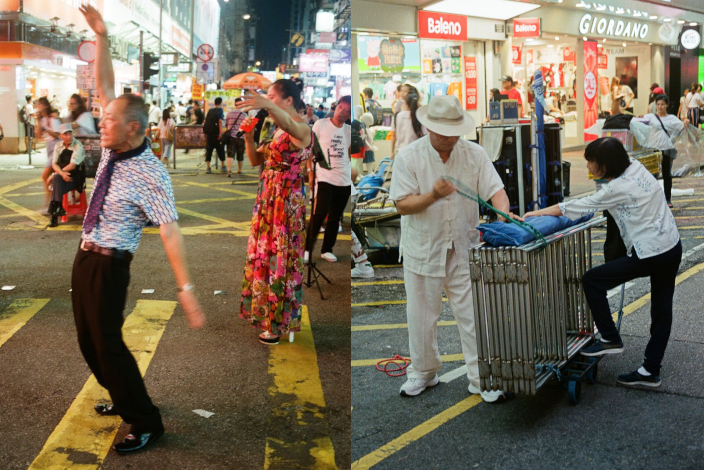
Within a few years, amateur performers began to use the pedestrian area as a stage, taking over the busy thoroughfare with sequined costumes and loudspeakers each week. Activists, retirees, and street artists were also drawn to the area, and Sai Yeung Choi Street gradually became a sort of outdoor public nightclub, where the inhabitants of Hong Kong’s cramped apartments had room to socialize and express themselves free of charge.
 |
A man and his dog sit among the audience while an amateur band performs on Sai Yeung Choi Street South on July 2. Photo: Teng Jing Xuan/Caixin |
Many of the Sai Yeung Choi Street performers who turned up to take their last bow on Sunday were veterans of its open-air stage. Yip, the retired police officer, said he had been singing in Mong Kok for over six years, and was drawn to the area because he wanted to fulfill the “musical dream” of his youth.
Hong Kong has a few other pedestrian zones, but none as spacious as Sai Yeung Choi Street, said Cheng, the dental nurse. She will now have to give up her drum kit and switch to playing the electric guitar when she performs in public because of a lack of space, Cheng told Caixin.
There were also old regulars among the audience, including a 70-year-old man surnamed Ho, who said he had been coming to Sai Yeung Choi Street for seven years. Here, he could have an entire night’s entertainment for just the price of a subway ticket — a rare pleasure for an elderly person without much income, he told Caixin.
A man surnamed Ting, another audience member who had been visiting the street for years, said that performers varied greatly in quality, and that he had a habit of handing out HK$20 ($2.55) tips to the better performers. Tipping performers, while technically illegal and considered a form of begging, was a common practice in the pedestrian area.
 |
A singer collects tips from audience members during a performance on Sai Yeung Choi Street South on Sunday. Photo: Liu Yanfei |
Although some people, like Yip and Cheng, mourn the end of Sai Yeung Choi Street’s weekend performances, others are ambivalent about the Hong Kong government’s decision.
“It’s very chaotic, and no one likes chaos,” a man surnamed Chan, who was singing at the same booth as Penny Kam, told Caixin. He said he “neither objected to nor supported” the shutdown, explaining that, while he enjoyed performing on the street, it was probably uncomfortable for passers-by or tourists to navigate the congested pedestrian area.
At times, as many as 27 different performance booths were active on the street at the same time, using their loudspeakers as weapons in the fight for pedestrians’ tips, Ting said.
Nearby residents have to endure hours of noise, so the decision to close the pedestrian area is understandable, Ma Fung-kwok, Hong Kong’s Legislative Council member for Sports, Performing Arts, Culture and Publication, told Caixin. But it is also a pity for Hong Kong to lose such a unique place, Ma said.
“The Hong Kong government currently has no regulations for street performers, so the police can only play a supporting role,” Ma said, adding that he hopes the government will implement rules for the size, scale, and quality of street performances, and possibly encourage quieter forms of street performance like mime or visual art.
At 9:59 p.m. on Sunday, a minute before the end of Sai Yeung Choi Street’s weekend pedestrian hours, Chan and other performers gathered to dance and sing “Auld Lang Syne.” When the clock struck 10 p.m., police officers ushered lingering pedestrians back onto the sidewalk. Minutes later, cars began trickling in, and the curtain came down for the last time on Hong Kong’s raucous, contentious Sai Yeung Choi Street South pedestrian zone.
 |
Sai Yeung Choi Street South is packed with performers, fans, tourists, and passers-by on its last weekend as a pedestrian zone. Photo: Liu Yanfei/Caixin |
- GALLERY

- PODCAST

- MOST POPULAR

 Sign in with Google
 Sign in with Facebook
 Sign in with 财新