

CBIRC Backs Certain Off-Balance Sheet Financing
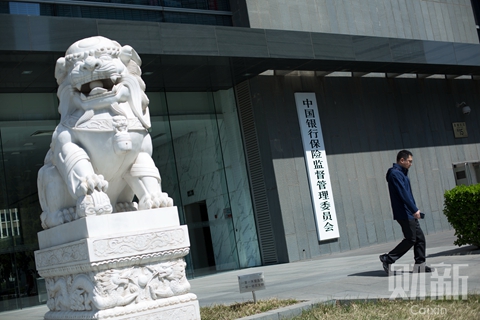
While continuing tight controls on financial risks, China’s banking regulator signaled that policymakers may loosen constraints on off-balance sheet financing in certain circumstances.
In the face of slowing growth and an escalating trade war that have spurred a shift toward more pro-growth policies, regulators are paying close attention to changes in China’s total outstanding social financing without loosening strict supervision, said Xiao Yuanqi, China Banking and Insurance Regulatory Commission’s (CBIRC) spokesperson, at a press conference Friday.
“We will not relax our efforts to ensure that financial risks are effectively controlled and maintain financial stability, while maintaining financial support for the real economy at the same time,” Xiao said.
In the governance of off-balance sheet financing, Xiao said the CBIRC has always taken a “partly crackdown and partly support” approach. For off-balance sheet financing that directly supports the real economy, regulators would encourage and regulate the development, Xiao said.
Crackdowns would focus on off-balance sheet financing through the channeling business, he said. In channeling, banks, companies and high-net-worth individuals invest customer deposits or their own cash in high-yield products via “channels” — which are usually nonbank vehicles such as trusts — to achieve higher returns.
Nearly 80% of the decline in trust loans so far this year has been in the channeling business, but non-channeling trust loans increased in line with regulators’ goal, Xiao said.
Annual growth in China’s outstanding total social financing, which includes off-balance sheet financing, slowed to 9.8% in June, the lowest on record, data from the central bank showed.
The growth in total social financing rose slightly in July and August, but much of the credit growth came from a sharp rise in banks’ short-term bill financing, showing that banks are still reluctant to extend loans to businesses.
Adding to signs of fading credit confidence, an increase in formal bank lending has barely compensated for shrinking off-balance sheet shadow loans, which have been an important source of funds for cash-starved private companies because they cannot obtain financing through regular bank loans or bonds.
Combined trust loans, entrusted loans and undiscounted bankers' acceptances, which are common forms of shadow banking finance, fell by 267.4 billion yuan in August from a year earlier, following a slide of 1.75 trillion yuan in the first seven months, data from the central bank showed.
In recent months, with U.S. tariffs threatening to add pressure on China’s already slowing growth, the government has been ramping up infrastructure spending and loosening monetary policy.
In July, China’s central bank injected 502 billion yuan ($73.9 billion) of cash into the banking system through loans to commercial banks, a move to encourage banks to increase lending to small companies and invest in corporate bonds.
The State Council, China’s cabinet, also unveiled a pro-growth package in July, including a 1.35 trillion yuan spending plan for local government infrastructure projects.



- 1China Clarifies Offshore Trust Tax Rules Ahead of Oct. 22 Deadline
- 2Micron Taiwan Workers Stage Strike Seeking Bigger Share of AI Profits
- 3Cover Story: China’s Power Retailers Reel as Cheap Deals Backfire
- 4China Steps Up AI Investment With $9 Billion Fund Backing Model Developers
- 5China’s EV Exports Double in September Ahead of Tax Rebate Cut

- 1Power To The People: Pintec Serves A Booming Consumer Class
- 2Largest hotel group in Europe accepts UnionPay
- 3UnionPay mobile QuickPass debuts in Hong Kong
- 4UnionPay International launches premium catering privilege U Dining Collection
- 5UnionPay International’s U Plan has covered over 1600 stores overseas

 Sign in with Google
 Sign in with Facebook
 Sign in with 财新