

Spring Festival Gala Actor Accused of Plagiarism
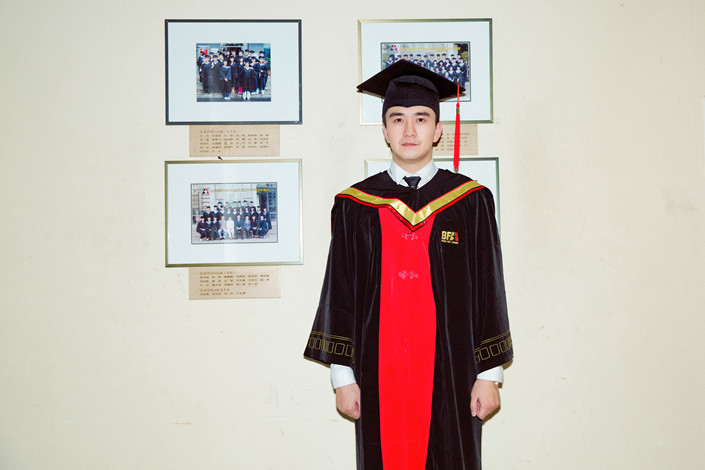
An actor who performed on China’s most-watched annual TV show this year has been accused of academic plagiarism, sparking a national debate on whether China’s education system gives celebrities special treatment.
Zhai Tianlin, the star of TV shows including 2017’s “White Deer Plain,” appeared in the 2019 Spring Festival Gala on Feb. 4. The annual production, broadcast by CCTV to celebrate the Lunar New Year, attracted 1.2 billion viewers this year.
A day later, doubts about Zhai’s academic qualifications — which include an impressive-sounding Ph.D. from the prestigious Beijing Film Academy — began circulating on the Chinese internet.
Social media users dug up a clip from a livestreamed Q&A with Zhai last year that appeared to show the actor’s ignorance of a major academic database. When asked if his thesis was available on Zhiwang, or China’s National Knowledge Infrastructure (CNKI) platform — a state-backed digital library that functions like JSTOR — Zhai looked confused and asked, “What’s Zhiwang?”
Commenters questioned how Zhai could have earned his Ph.D. if he knew nothing about a basic research tool like CNKI. Zhai also appears to have published no papers in any reputable academic journals, despite BFA’s rule that Ph.D. candidates must publish at least two articles, including one in a “key domestic journal.”
Additionally, an article Zhai published in May 2018 in an entertainment industry magazine was allegedly found by a Weibo user to be suspiciously similar to content written by Huangshan University academic Huang Lihua around a decade ago.
Zhai’s representatives denied that the actor didn’t know what CNKI was, claiming his apparent ignorance was intended to be a joke about the “tough endeavor” of thesis-writing. They added that Zhai had fulfilled BFA’s Ph.D. requirements, but did not provide details on the relevant papers published by Zhai, who is also a post-doctoral research fellow at Peking University’s Guanghua School of Management.
Zhai’s case has prompted Chinese social media users to question if the country’s top schools unfairly apply lower standards when considering celebrity candidates for research positions.
The state-run publication People’s Daily joined the debate Monday, calling on BFA and Peking University to respond to doubts about Zhai.
BFA said later that day that it had set up an investigation team to look into Zhai’s case, and that Peking University would take action based on the results of BFA’s investigation.
Chinese academia has long struggled with allegations of dishonesty and misconduct. In April 2017, academic publisher Springer Nature took down more than 100 research papers by Chinese academics suspected of faking peer reviews and of plagiarism.
Contact reporter Zhao Runhua (runhuazhao@caixin.com)


- 1Chinese Politburo Member’s Downfall Exposes Shadowy Network Tied to Evergrande, Vanke
- 2Hong Kong Grapples With Near-One-Year High in Covid-19 Infections
- 3Top Chinese Cancer Doctor Accused of Academic Fraud in ‘Paper Mill’ Scandal
- 4Chinese Consumers Tighten Purse Strings Despite Modest Income Gains
- 5Analysis: China’s AI Boom Masks a Deepening Economic Divide

- 1Power To The People: Pintec Serves A Booming Consumer Class
- 2Largest hotel group in Europe accepts UnionPay
- 3UnionPay mobile QuickPass debuts in Hong Kong
- 4UnionPay International launches premium catering privilege U Dining Collection
- 5UnionPay International’s U Plan has covered over 1600 stores overseas

 Sign in with Google
 Sign in with Facebook
 Sign in with 财新