


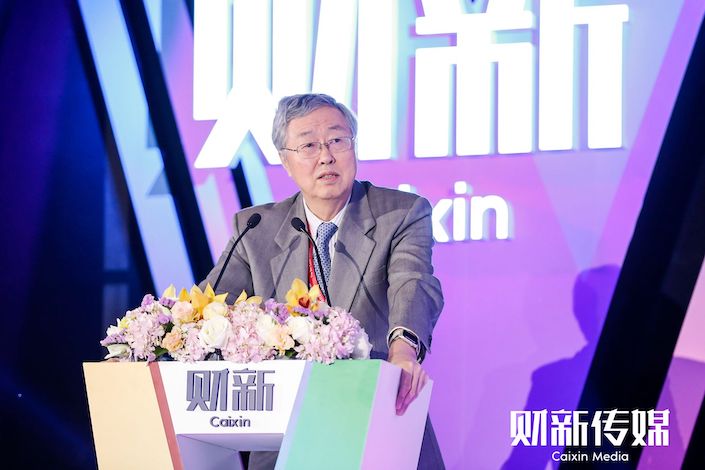
Former governor of China's central bank, Zhou Xiaochuan
Live updates from the 9th Caixin Summit: Global Challenges, Global Solutions, underway this week in Beijing. Follow talks from key figures in government, business and academia, including:
—Zhou Xiaochuan, former PBOC chief
—Paul Romer, Nobel Prize-winning economist
—Yi Huiman, chairman of the Industrial and Commercial Bank of China
—Charlene Barshefsky, United States Trade Representative (1997-2001)
—And more
-----------
Update: 11:07 a.m.
Trade War Priorities
Long Yongtu, former Chief Representative for Trade Negotiations, Former Vice Minister of China’s Ministry of Foreign Trade and Economic Cooperation
"Trade negotiators are reluctant to talk about deep-rooted issues. Rather, they prefer to deal with a matter on its merits. Agricultural products are sensitive in trade talks. China should have targeted other goods before going for soybeans. But the fact that soybeans are among the first to be affected clearly shows the government has other considerations."
-----------
Update: 12:21 p.m.
Skepticism Over Financial Technologies
Zhou Xiaochuan, former governor of the People's Bank of China
Zhou suggested caution toward new technologies such as blockchain, expressing doubt about whether decentralization — touted by the tech industry — is the most needed feature for financial and payment systems.
He blasted new fintech products that were launched prematurely on the market "for financial gain," which distorted the market. Some companies are not interested in developing new technologies to improve financial services, he said. Rather, they focus on how the technology can give them access to public deposits, pointing to the P2P industry's fund-pooling practices and some payment companies' attempt to accept public deposits like banks do.
Zhou also said he was concerned that aggressive expansion by leading internet firms may undermine competition and hinder innovation.
-----------
Update: 1:59 p.m.
Waning Relevance of WTO
Charlene Barshefsky, United States Trade Representative (1997-2001)
Barshefsky called on the WTO to update its rules to keep up with the development of the global digital economy. Otherwise, she warned, the organization will become increasingly irrelevant.
Barshefsky observed that the WTO has seen its status decline as an effective framework of solving trade frictions over the past decade. “The WTO system has been arguing over the old economic problems for the past 17 years and it has been unsuccessful,” she said.
Barshefsky said the organization’s regulatory framework has been way behind the development of global economy, and that it has failed to take account of the fast-developing digital trade economy. The fact that the most recent round of WTO negotiations took place in 1994, and was based on an agenda set in 1982, shows how outdated the rules are, she added.
Barshefsky also warned that the U.S. and China, as the world’s two largest economies, should not use their concerns over national security as an excuse to promote unilateralism.
“If the big guys break the rules, everyone will think that they can break the rules,” Barshefsky said.
----------
Update: 4:14 p.m.
Communication Among Central Banks
Robert Hormats, Vice Chairman of Kissinger Associates and Former Vice Chairman of Goldman Sachs
 |
Robert Hormats |
To prevent global financial turbulence, the Federal Reserve needs to strengthen its communication and cooperation with other central banks, Hormats said.
Hormats said the Fed should host private communication channels with other central banks to keep them informed on the direction of its monetary policy.
Decisions made by the Fed have significant impact on the rest of the world, especially on emerging economies. In the past, the Fed has not been particularly transparent about the direction of its monetary policy, which has led some countries to be caught off guard, increasing the risk of financial turbulence, according to Hormats.
Without a clear understanding of where the Fed is heading, other central bank governors could have great difficulty setting sound monetary policy in their home countries. And as all countries are interdependent, such cooperation is essential to the stability of the global financial system, Hormats said.
-------------
Update 5:13 p.m.
Trade War Forecast
Lou Jiwei, Chairman of the National Council for Social Security Fund, Standing Committee Member and Chairman of the Committee of Foreign Affairs of the CPPCC
China’s former finance minister Lou Jiwei said China’s engagement with the U.S. will continue even though the structural disagreement between the world’s two largest economies is unlikely to be solved any time soon.
Lou, who now chairs the National Council for Social Security Fund, expressed hope for the planned Trump-Xi meeting on the sidelines of the G-20 summit later this month.
Trade talks between the world’s two largest economies have been deadlocked for the past few months. China and the U.S. have imposed tariffs on half the annual imports from each other, followed by heated rhetoric and saber rattling in the South China Sea.
Lou said the U.S. will be more careful in imposing punitive tariffs on the remaining $250 billion worth of Chinese imports. The Chinese goods that escaped previous rounds of tariffs are ones, if taxed, that will impose higher marginal costs on the U.S. than on China, he added.
“The downward pressure on the global economy triggered by the trade war and unilateralism will be transmitted back to China and the U.S.,” Lou said. “The U.S. remaining competitive in the process of globalization is a high probability, but ‘America First’ cannot be sustained.”
Follow our full Caixin Summit coverage at CX Live.

 Sign in with Google
 Sign in with Facebook
 Sign in with 财新