

China Plans to Tighten Rules on $2 Trillion Corner of Market
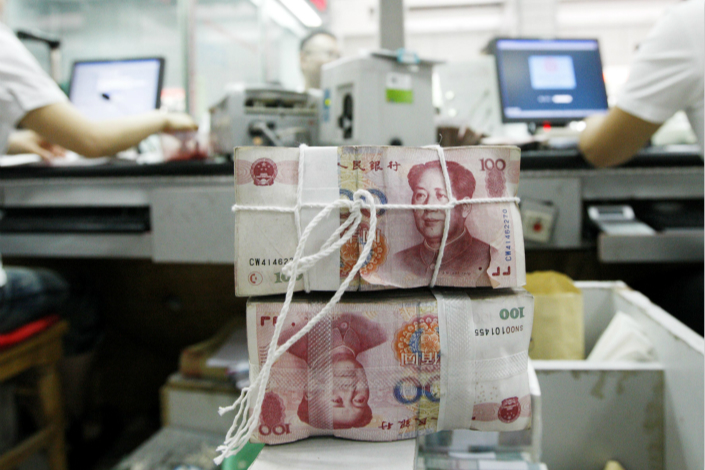
(Bloomberg) — China’s banking regulator plans to tighten rules on so-called cash-management products (CMPs), according to people familiar with the matter, affecting an estimated $2 trillion of investments.
The China Banking and Insurance Regulatory Commission (CBIRC) aims to treat CMPs similarly to money market funds by imposing stricter rules on pricing and restricting where and for how long the inflows can be invested, the people said, asking not to be identified as the deliberations are private. CMPs are issued by banks and are more liquid than money market funds, which are sold by asset managers.
Looser regulation of CMPs currently allow banks to offer higher yields than those on money market funds. The CBIRC’s changes could damp their investment appeal, the people said. The moves are another step in China’s fight against financial risk as policymakers try to contain the fallout from rising defaults and slowing economic growth.
“CMP yields will drop and gradually lose their comparative advantage over money market funds,” said Liao Chenkai, a Shanghai-based analyst at Capital Securities Corp., who predicts some decline in banks’ fee income. “But given that most investors buy the products for their liquidity instead of yield, I don’t expect a significant hit to the scale of the market.”
The CBIRC didn’t immediately reply to a fax seeking comment.
Money market funds, overseen by the securities regulator, cap duration of their investments at an average 120 days while there’s no such time limit for CMPs. The CBIRC also wants to make pricing stricter by curbing so-called deviation, the people said.
Asset managers are allowed to calculate the net asset value (NAV) of a money-market fund in two ways. However, when the NAV under one method deviates beyond a specified amount from the other, the fund is required to take measures such as limiting new subscriptions or even liquidating assets.
CMPs accounted for more than 13 trillion yuan ($2 trillion), or about 60% of outstanding wealth management products (WMPs) in June 2018, according to data from Jinniu Wealth Management. Individuals hold nearly 90% of WMPs, mainly because many believe they’re shielded from losses — a view officials have tried hard to discourage.
WMPs are issued by banks and typically offer yields of 2% to 5%, compared with 1.5% on one-year bank deposits. They can invest in anything from bonds and stocks to property. Like mortgage-backed securities in the U.S., WMPs became key building blocks of a shadow-banking system that existed largely off banks’ balance sheets.

- RELATED



- MOST POPULAR

 Sign in with Google
 Sign in with Facebook
 Sign in with 财新