



A city in the border province of Jilin has gone back into “silent management” of its Covid risk, barring all of its 3.6 million residents from leaving their residential communities unless necessary, three months after a lockdown was called in the province when omicron cases were detected.
Authorities in Jilin city implemented the measure after finding a single Covid case in the community Sunday. The measure will last from Monday through Wednesday, during which authorities will conduct three rounds of mass testing. Authorities said people who don’t take a test during the three-day period will be given a yellow “health code,” which means they will still be restricted from moving freely after “silent management” ends.
The northeastern province, which borders Russia and North Korea, put all of its 24 million residents under lockdown in mid-March after a spike in cases.
Other control measures have also been put in place. The city is suspending public transportation services, dine-in services at restaurants in densely populated areas, and in-person classes at its kindergartens and primary schools from Monday to Wednesday. On Tuesday, Jilin authorities said they had discovered 10 more Covid cases on Monday. All were workers processing imported cold-chain food products at a local factory and were close contacts of the first patient of the new outbreak, authorities said.
Contact reporter Wang Xintong (xintongwang@caixin.com) and editor Heather Mowbray (heathermowbray@caixin.com)
Download our app to receive breaking news alerts and read the news on the go.
Get our weekly free Must-Read newsletter.

Pedestrians walk past closed bars on Thursday in Beijing’s Chaoyang district. Photo: VCG
Beijing has reimposed tough Covid measures in its most populous district, including closing entertainment venues, after a growing cluster of infections linked to bars ended a five-day streak of no community spread.
Nearly 30 Covid patients, detected in 12 of the city’s 16 districts between Thursday and Friday afternoon, were found to have links with Heaven Supermarket, a bar near the Worker’s Stadium in Chaoyang district, authorities said at a press conference Friday. Of them, 26 had visited the bar early this week, authorities said.
Not all of the bar’s recent visitors had scanned the bar’s QR code with their health code app, or had their temperature and recent Covid test results checked on entering, making contact tracing harder, authorities said, noting that the city expected more cases to emerge among bar-goers and their close contacts.
Chaoyang district — home to roughly 3.5 million people and many foreign embassies — shut down all internet cafe and entertainment venues like karaoke parlors on Thursday, after learning that three new Covid patients had visited the Heaven Supermarket bar. Two other positive cases were later found to have visited the bar and several others in Sanlitun and the Worker’s Stadium area.
The district also kicked off mass testing in several neighborhoods on the same day, including in Sanlitun and the nearby residential neighborhoods of Tuanjiehu and Hujialou, local authorities said.
Before the new cases, Beijing had reported no new cases outside quarantine zones for five days. On Monday, the city relaxed Covid rules it had imposed on most of its districts, such as a ban on dining-in at restaurants and work-from-home orders, as it moved to return to normalcy after declaring the latest outbreak under control.
Contact reporter Wang Xintong (xintongwang@caixin.com) and editor Heather Mowbray (heathermowbray@caixin.com)
Download our app to receive breaking news alerts and read the news on the go.
Get our weekly free Must-Read newsletter.

People dine in a restaurant on Monday in Beijing. Photo: VCG
Beijing relaxed Covid rules for most of the city’s districts on Monday, allowing restaurants there to restart dine-in services, as the capital moves to return to normalcy after declaring it had the latest outbreak under control.
In all districts except Fengtai and some parts of Changping, the city also reopened scenic areas, parks and indoor venues like cinemas, albeit at 75% capacity, on Monday. Beijing resumed public transport in these districts on the same day, allowing workers who had been asked to work from home to return to the office, according to a state media report.
Residents who wanted to enter a public venue or office building would need to hold a negative Covid test result obtained within 72 hours, longer than the previously required 48 hours, the report said. The city planned to gradually resume in-person teaching, with most primary and middle school students going back on June 13 and kindergarten pupils returning on June 20, the report added.
The report came after officials said at a press conference Friday that 13 of the city’s 16 districts had reported no new cases outside quarantine for seven straight days and had achieved the goal of “no community spread,” a key government precondition for lifting restrictions. Before the report, most restrictions had been in place for a month or so, although some were relaxed in certain districts in late May.
Beijing officials declared Saturday that the local outbreak has entered its final stage, while reiterating that they would keep to the “zero-Covid” policy in holding the virus at bay. As China battled its worst outbreak in two years, public frustration has been on the rise over the policy, especially in Shanghai which has just lifted a two-month lockdown.
The country reported 86 local infections Sunday, mostly in the northern region of Inner Mongolia, according to the National Health Commission (NHC). Both Shanghai and Beijing reported single digit new cases.
At a Sunday press conference, NHC official Lei Zhenglong urged local governments to balance their Covid response with economic and social development in a more effective way. He also called on authorities to prohibit certain acts, such as casually quarantining residents from low-risk Covid areas and extending the isolation period for residents already in quarantine.
Contact reporter Wang Xintong (xintongwang@caixin.com) and editor Heather Mowbray (heathermowbray@caixin.com)
Download our app to receive breaking news alerts and read the news on the go.
Get our weekly free Must-Read newsletter.

Beijing’s southwestern district of Fengtai has asked most of its 2 million residents to work from home starting Tuesday, while prohibiting anyone from entering or leaving the district unless necessary.
The restrictions (link in Chinese) will be tentatively effective until Sunday. They came after the capital reported 18 local Covid cases yesterday, only one of which was found outside quarantine areas. The case was from Fengtai, authorities said.
Monday’s case was the first local community infection in the capital in three days. It means “the risk of a rebound still exists,” city officials told a Tuesday press conference, vowing to eliminate any community cases as soon as possible.
At the press conference, officials also said Beijing detected a community case in Changping district Tuesday, though the number of daily Covid cases in the city has fallen for nine straight days. Changping will kick off three new rounds of testing for residents in certain areas from the same day, officials said.
It remains unclear how the new cases will affect the city’s anti-Covid efforts as a whole. After local authorities said over the weekend that the city’s month-old outbreak was under control with no new community cases found the previous day, Beijing relaxed Covid curbs in the districts of Chaoyang, Shunyi and Fangshan, including lifting work-from-home rules for most residents living there and largely resuming public transportation.
Contact reporter Wang Xintong (xintongwang@caixin.com) and editor Lu Zhenhua (zhenhualu@caixin.com)
Download our app to receive breaking news alerts and read the news on the go.
Get our weekly free Must-Read newsletter.

On May 28, cleaning staff spray a Shanghai street. Photo: VCG
Shanghai announced Saturday that it will allow businesses in all sectors to resume operation starting on June 1 and released a package of supportive policies to reboot local economy as the city’s worst-ever Covid-19 outbreak has been largely contained after two months of strict lockdown.
However, as of Monday, the local government has not yet fully lifted restrictions to allow people to freely commute between their communities and workplaces, and public transport services have also not been completely resumed.
Local authorities have said that, starting on Wednesday, all sectors including small and medium businesses can restart their operations without the need to seek government approval. Major industries have been gradually resuming their operations with approval from the government since early May.
The financial hub also aims to reboot its local economy, which was devastated during the lockdown, with a package of 50 measures including tax relief, rent reduction and exemption, as well as support for exporters and foreign investors.
But residents across the megacity of 25 million are not yet been allowed to move freely. According to a notice posted on social media, residents in the Pudong New Area town of Gaoqiao could only move around within the premises of the township on Monday and Tuesday. In a community in the central district of Jingan, residents must show proof of a negative nucleic acid test result before going out.
In mid-May, Shanghai announced its three-phase plan for businesses to fully reopen and life to return to “normal” by the end of June after all the city’s 15 districts have achieved the goal of no community spread — meaning no new cases were found among residents who weren’t already in quarantine — for the past three days.
 |
A notice posted on social media says residents in the Pudong New Area town of Gaoqiao are only allowed to move around within the premises of the township on May 30 and 31. Photo: Social media |
Contact reporter Lu Zhenhua (zhenhualu@caixin.com) editor Michael Bellart (michaelbellart@caixin.com)
Download our app to receive breaking news alerts and read the news on the go.
Get our weekly free Must-Read newsletter.

picture
The city of Langfang, Beijing’s neighbor to the southeast that is a major source of commuters to the Chinese capital, was placed under a three-day lockdown Sunday amid a new local outbreak of Covid-19.
The Hebei province city has launched mass testing for Covid-19 to identify further positive cases in its population of 5 million after three consecutive days of discovering 30 nonsymptomatic cases since Saturday.
On May 19, local disease prevention and control authorities warned of a “severe and complex" situation in the city due to outbreaks in neighboring regions including Beijing and the port city of Tianjin.
Intercity commuters living in Langfang have been asked to report their recent travel history to their local community office. Residents have also been told to avoid unnecessary travel outside the city.
On Saturday, Beijing said it had contained its latest wave of Covid-19, after a month in which nearly 1,800 people were infected. In nearby Tianjin, the daily tally of positive cases dropped to single digits on Sunday.
Contact reporter Lu Zhenhua (zhenhualu@caixin.com) editor Heather Mowbray (heathermowbray@caixin.com)
Download our app to receive breaking news alerts and read the news on the go.
Get our weekly free Must-Read newsletter.

Tianjin's Heping district on May 25. Photo: VCG
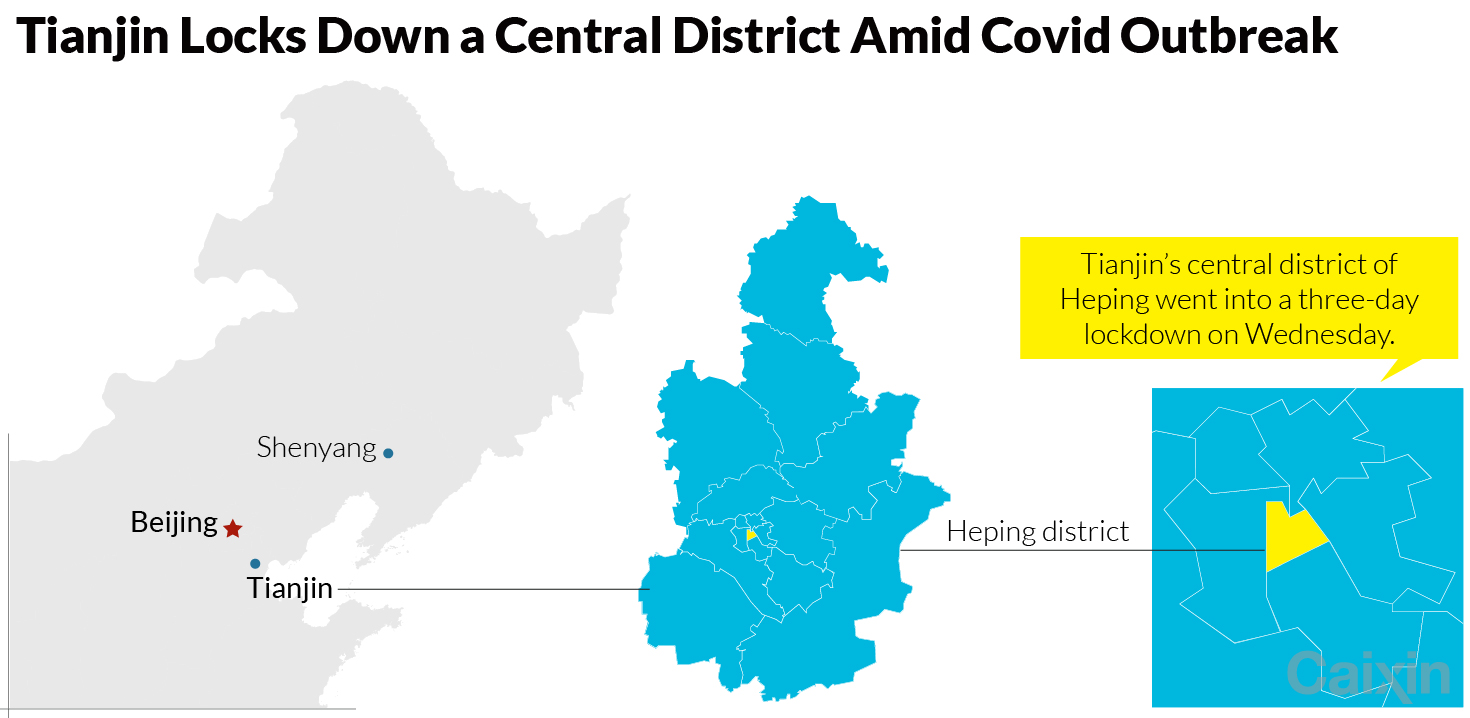
Tianjin has locked down one of its central districts and kicked off a new round of citywide testing to contain its latest local outbreak of Covid-19. The restrictions came as the port city’s health authorities reported 18 local cases Wednesday, up from 17 a day earlier.
More than 350,000 residents of Heping district have been put under “static management” since Wednesday, which means they cannot leave the district unless necessary, state media reported, citing local health authorities (link in Chinese). Most residents are confined to their homes, residential communities or neighborhoods.
Residents who need to leave are required to either hold a special vehicle license or provide special services, such as in medical care or epidemic control, the report said, adding that the measures will be tentatively effective for three days.
Tianjin also initiated a new round of citywide testing yesterday, while asking all of its 14 million residents to largely reduce their movement until the test results are out.
Of the 18 cases reported, some were from the central Nankai and Hebei districts. Authorities in Hebei district are banning dining-in at restaurants from Thursday to Saturday.
 |
On the internet, there was chatter that Nankai would go into lockdown, but local authorities put out a statement to quash the speculation. They also called for residents not to believe or further spread the misinformation.
Contact reporter Wang Xintong (xintongwang@caixin.com) and editor Bertrand Teo (bertrandteo@caixin.com)
Download our app to receive breaking news alerts and read the news on the go.
Get our weekly free Must-Read newsletter.

Passengers line up at the entrance of Hongqiao Railway Station in Shanghai, on May 19. Photo: Courtesy of interviewees
After a grueling six-hour walk, Chen Peng finally arrived at the vicinity of the Shanghai Hongqiao Railway Station early Thursday morning, only to discover a queue stretching for nearly 2 kilometers of travelers waiting to enter the station.
The railway station is a key transport hub for intercity travel, for leaving and arriving in Shanghai. With the city easing lockdowns, many had flocked to the station to proceed with travel plans that were hijacked by Covid restrictions.
Although Chen had endured a long morning, the long queue did not deter him. “I’ve thought of giving up several times, but I told myself (I) must leave Shanghai, (I) can’t stop … This motivated me to pursue heading to my destination,” Chen said.
 |
People walk to Hongqiao Railway Station on May 19. Photo: Courtesy of interviewees |
After grabbing a bite by the roadside, Chen collected himself and joined the queue, where he waited another two hours.
Like Chen, Shanghai’s two-month lockdown had been the stuff of nightmares, and the move toward a full reopening plan have galvanized many to push ahead with the travel plans at all cost, whether it is to reunite with their families or go to other cities for work.
Paying a premium
Pan Ziying’s university entered a lockdown on March 13 and students were barred from leaving campus. On April 4, the university escalated the restriction asking Pan and others to stay at their dormitory. The students couldn’t use delivery or takeaway services too. Thus, Pan had to survive on boxed meals delivered by volunteers, the student told Caixin.
“I had nightmares of hiding from zombies, vampires, and taking refuge in a subway station, but I had never imagined that I would eat boxed meals in a room for two months,” said Pan.
On May 10, Pan saw light at the end of the tunnel, when the university announced that students were allowed to leave Shanghai. She then decided to return to her hometown in Nanjing, East China’s Jiangsu province. But getting a train ticket became her next challenge, as seats were limited and sold out within seconds after going on sale.
 |
People wait to be released at the first checkpoint on May 19. Photo: Courtesy of interviewees |
In the end, Pan had to pay a premium for a ticket through a travel agent — an additional 100 yuan ($15). She also had to take an unlicensed car to Hongqiao station, where she and other passengers paid a total of 1,100 yuan to the driver.
Spending the night in a converted parking lot
Unlike Pan, there are those who failed to leave Shanghai. Zhao Yang was due to leave the city on May 16, but he missed his train. One major reason was that he wasn’t able to complete the procedures required to enter Hongqiao station in time.
Zhao told Caixin the train he planned to get on was meant to depart at 12:07 p.m. Even though he got to Hongqiao station an hour before time, he did not foresee the long line of travelers waiting to get their Covid test results checked, before entering the station.
Zhao was one of about two dozen people who failed to catch up the train that day, he said. He was later taken to a makeshift facility converted from a parking lot, where no beds were provided.
Despite the discomfort, Zhao said he slept, while some others sat up all night.
 |
Passengers stranded at a railway station in Shanghai gather at a makshift waiting area converted from a parking lot on May 16. Photo: Courtesy of interviewees |
When asked about how the others with him were stranded, Zhao said they missed the train for various reasons. “Some people’s (negative) test results had expired, some hadn’t been able to get their new test results, some experienced incidents on the way (to the station), and others, like me, missed the train’s departure time.”
“It’s not easy for everyone to get here,” he said.
Contact reporter Wang Xintong (xintongwang@caixin.com) and editor Bertrand Teo (bertrandteo@caixin.com)
Download our app to receive breaking news alerts and read the news on the go.
Get our weekly free Must-Read newsletter.

Chinese Vice Premier Sun Chunlan. Photo: CCTV screenshots
Chinese Vice Premier Sun Chunlan has urged authorities in Beijing to take more “thorough” measures to stop the spread of Covid-19 in the community, moving faster to transfer and isolate infected people and their close contacts as an outbreak has dragged on for a month.
She also reiterated the country’s adherence to the “zero-Covid” policy Monday when she visited some places in the capital which recently reported clusters of infections, state media reported. The places included several in Haidian district, home to some of China’s top universities.
Sun’s remarks are a sign that Beijing may further tighten Covid curbs, though the current stringent measures — regular mass testing, centralized quarantine and work-from-home orders — have affected millions of local residents.
The city reported 48 local infections Monday, down from the current outbreak’s daily peak of 99 on Sunday. It has logged more than 1,500 local cases since April 22, according to local authorities.
Beijing has ramped up Covid quarantine. On Monday, Haidian authorities said in a statement (link in Chinese) that more than 1,800 residents of a local community had been sent to the neighboring city of Zhangjiakou for centralized quarantine.
The transfer is aimed at minimizing the risk of Covid spread within the community, after several positive cases were found there, according to the statement. The transferred residents will be isolated for at least seven days at hotels that once “served international events,” the statement said. Zhangjiakou was a co-host city of the Beijing Winter Olympics that took place earlier this year.
Last week, nearly 5,000 residents from a community in the city’s Chaoyang district were taken to hotels for seven days of centralized quarantine, after more than two dozen cases were identified in the community already in lockdown.
The mass transfers have sparked concerns online, with some saying that transferring healthy residents from home to centralized quarantine facilities would increase their risk of infection. Others questioned whether the transfers are only meant to clear the virus cases from official numbers.
Some cities like Beijing and Shanghai use “zero community spread” as the criteria to consider an outbreak as having been contained, and Covid cases found among those in centralized quarantine are not counted as community cases.
Also on Monday, Beijing asked companies and institutions subject to work-from-home requirement to limit the number of workers at office to 30% of their normal levels. The city has told residents in six areas, including Chaoyang and Haidian, to work from home until Saturday, Bloomberg reported.
Contact reporter Wang Xintong (xintongwang@caixin.com) and editor Lu Zhenhua (zhenhualu@caixin.com)
Download our app to receive breaking news alerts and read the news on the go.
Get our weekly free Must-Read newsletter.

What’s new: China continued to suspend group overseas tours and discourage individuals from going abroad for sightseeing or visiting friends and families as a part of efforts to contain the Covid-19 pandemic, the country’s immigration office said Monday.
The National Immigration Administration advised citizens not to leave China unless necessary and said those who have overseas travel plans should take full account of the risks and uncertainties of doing so, said Liu Haitao, director general of the administration’s Department of Frontier Inspection and Management, at a routine press conference Monday.
Immigration authorities will process documents in a timely manner for those who need to go abroad for epidemic prevention and control work, medical treatment, delivery of relief supplies or production and living materials, participation in key engineering projects or organized labor groups, business purposes, scientific research purposes or academic purposes, Liu said.
Necessary overseas travel also includes those who need to look after severely sick people, help take care of seniors, children or pregnant women, and attend relatives’ weddings, graduations and family reunions, the official said.
The latest policies mean it will be almost impossible for outbound tourism to resume in the short term, and inbound tourism is not attractive to foreign visitors, said Zhou Mingqi, founder of tourism consultancy firm Jingjian Consulting in Shanghai.
The background: Under the “zero-Covid” policy, China has been restricting both inbound and outbound international air travel since early 2020.
China’s civil aviation regulator vowed in April to firmly stick to the zero-Covid policy and general strategy to “prevent imported cases and resurgence of internal cases” as the country battles the worst pandemic outbreak in two years.
Since the beginning of 2022, China has suspended 664 international flights, about 40% of the total number of suspended flights since circuit-breaker measures were put in place in June 2020, the Civil Aviation Administration of China (CAAC) said.
Quick Takes are condensed versions of China-related stories for fast news you can use. To read the full story in Chinese, click here.
Contact reporter Denise Jia (huijuanjia@caixin.com) and editor Bob Simison (bob.simison@caixin.com)
Download our app to receive breaking news alerts and read the news on the go.
Get our weekly free Must-Read newsletter.

A barber offering haircuts for residents in Shanghai on May 19, 2022.
Shanghai is removing metal barriers around the city used to seal off streets and entrances to residential buildings as the largest city in China eases pandemic restrictions after Covid-related lockdowns lasting more than a month and a half.
Public transportation will resume Sunday, starting with four of the city’s 20 subway lines and 273 bus routes, basically covering all of the major districts, airports, train stations and hospitals in the city, an official said Thursday at a press conference. The government is studying plans to allow private vehicles and taxis back on road, the official said.
Since April 22, metal barriers primarily made from mesh fencing or thin sheets of metal were put up around the city to block streets and entrances to apartment complexes where Covid-19 cases were reported. The move drew criticism that the barriers posed fire hazards.
Several districts recently issued notices to remove road barriers to resume normal production and living, Caixin learned. Reporters saw that many metal fences in the Pudong district were demolished, and workers said they would remove all remaining fences in the next few days.
Meanwhile, small and medium-sized enterprises (SMEs) in Shanghai still face difficulties reopening. Only a small number of companies have resumed operation as many don’t meet pandemic prevention requirements, Deputy Mayor Zhang Wei said at the press conference.
The SMEs' resumption rate, which includes offline and online activities, is about 65%, lower than that of large corporations, said Wu Jincheng, director of the Shanghai Commission of Economy and Informatization.
Catering, entertainment and logistics companies are among those hit hard by the epidemic, Wu said.
Now through the end of May, reopened companies are required to operate under closed-loop or half closed-loop systems, in which workers sleep on site, Zhang said. In areas where no Covid cases are reported, eligible companies are allowed to provide shuttles for employees to commute between work and home. Starting in June, normal transportation between companies and residential communities in areas without epidemic risks will resume, Zhang said.
Shanghai reported 671 new cases and one death Wednesday, down 16% from the previous day, according to the local health authorities.
Contact reporter Denise Jia (huijuanjia@caixin.com) and editor Bob Simison (bob.simison@caixin.com)
Download our app to receive breaking news alerts and read the news on the go.
Get our weekly free Must-Read newsletter.

What’s new: The Chinese embassy in the U.S. has updated Covid guidelines for travelers flying to China, allowing them to enter the country without taking a nucleic acid test seven days before boarding from Friday onwards.
This testing was one of the requirements imposed in January because of a surge in omicron cases in the U.S.
The requirement for passengers to document their temperature and health condition for a week before their departure will also be removed, as will the requirement to take an antibody test, according to a statement (link in Chinese) published Tuesday by the embassy.
The guidelines still require travelers from the U.S. to China to take two nucleic acid tests within 48 hours of their flight, one of which must be conducted 24 hours before boarding, according to the statement.
The background: Before the latest change to the rules, travelers were asked to stay in their city of departure for seven days prior to flying for a period of “personal health observation.” During this period, they had to complete two rounds of pre-flight tests at embassy-designated testing agencies on the first of the seven days, and within 48 hours of their flight.
Quick Takes are condensed versions of China-related stories for fast news you can use.
Contact reporter Wang Xintong (xintongwang@caixin.com) and editor Heather Mowbray (heathermowbray@caixin.com)
Download our app to receive breaking news alerts and read the news on the go.
Get our weekly free Must-Read newsletter.

Residents wheel scooters through neighborhood barriers on Monday in Jinshan district, Shanghai as the city begins easing Covid-19 restrictions in stages. Photo: Yin Liqin/China News Service, VCG

What’s new: Shanghai announced Tuesday that it has achieved the goal of no community spread in all of its 16 districts, a key milestone in its over two-month battle with Covid that could embolden authorities to further ease restrictions.
The city hit the milestone three days before the target of Friday. This means all of the city’s new cases in the past three days were found among those in centralized quarantine or confined to their homes.
Zhao Dandan, deputy director of the Shanghai Municipal Health Commission, made the announcement at a press conference, while saying some 860,000 residents are currently stuck at home. The financial hub has struggled to contain its worst ever Covid-19 outbreak, reporting 823 local infections Monday, all in quarantine, local authorities said.
The background: The announcement came just a day after the city authorities said they had laid out a three-phase plan to gradually lift restrictions by the end of June, including a weeks-long lockdown which has triggered discontent among residents.
On Monday, local authorities said 15 of the city’s 16 districts had stamped out community spread.
Quick Takes are condensed versions of China-related stories for fast news you can use.
Contact reporter Wang Xintong (xintongwang@caixin.com) and editor Lu Zhenhua (zhenhualu@caixin.com)
Download our app to receive breaking news alerts and read the news on the go.
Get our weekly free Must-Read newsletter.

What’s new: China has pulled out of its commitment to host the 2023 Asian Cup due to the ongoing Covid-19 outbreak, soccer officials announced Saturday, as hundreds of millions of people across the country remain under some form of lockdown or subject to other strict controls on their movements.
“Following extensive discussions with the Chinese Football Association (CFA), the Asian Football Confederation (AFC) has been officially informed by the CFA that it would not be able to host the AFC Asian Cup 2023,” the confederation said in a statement.
The 24-nation tournament, held every four years, was scheduled to be hosted across 10 cities between June 16 and July 16 next year. China was awarded hosting rights in June 2019.
The AFC noted that “the exceptional circumstances caused by the Covid-19 pandemic” had led Chinese football organizers to make “this very difficult but necessary decision in the collective interests” of the tournament.
“Due to the impact of the pandemic, it is difficult for the Chinese Organizing Committee to pledge at this moment to hold next year’s Asian Cup under a fully open model,” the committee said in a statement on Weibo.
Earlier this month, China postponed the 2022 Asian Games, which were scheduled to be held in Hangzhou from September 10 to 25, also due to the Covid epidemic.
The background: The country is battling its worst Covid-19 outbreak since early 2020, with the government doggedly sticking to its “zero-Covid” policy by imposing strict lockdowns across the country including the financial hub of Shanghai and widespread mass testing to prevent further spread of the omicron variant.
As of May 10, 41 Chinese cities were implementing full or partial lockdowns or some kind of district-based control measures, which involve stringent measures on restricting mobility of local residents, according to a research note published by Nomura Holdings Inc. the same day.
It estimated that around 289.8 million people across China are currently affected by these lockdown measures.
Contact reporter Kelsey Cheng (kelseycheng@caixin.com)
Download our app to receive breaking news alerts and read the news on the go.
Get our weekly free Must-Read newsletter.

What’s new: Postal and courier services in Shanghai have slowly resumed to one-sixth of normal capacity as the city gradually eases Covid restrictions after more than a month of lockdowns.
Average daily delivery volume in the city reached 1 million parcels, and most courier companies were allowed to resume operations, including China Post, SF Express, Cainiao, JD Logistics, UPS and FedEx., an official at the Shanghai Postal Administration said Thursday.
Sixteen parcel distribution centers in the city resumed operations, with five more to follow soon, said Yu Hongwei, deputy director of the Postal Administration. The city will soon issue a second list allowing more postal and courier companies to resume operations, Yu said.
The context: Delivery disruptions caused by strict virus control measures sparked public outcries in the city of 25 million as people faced difficulties accessing daily necessities during the month-long lockdown.
On May 8, the municipal government listed 21 major delivery and logistics operations that were cleared to resume services as the city gradually pushes toward reopening.
Shanghai residents interviewed by Caixin said services resumed at major e-commerce sites, but delivery schedules remained uncertain.
“Some consumers might still be frustrated since there are still bottlenecks and difficulties," Yu said.
Quick Takes are condensed versions of China-related stories for fast news you can use.
Contact reporter Han Wei (weihan@caixin.com) and editor Bob Simison (bob.simison@caixin.com)
Download our app to receive breaking news alerts and read the news on the go.
Get our weekly free Must-Read newsletter.

What’s new: China announced Thursday that it “will strictly restrict” people from entering or leaving the country as it races to contain its worst wave of Covid-19 outbreaks since early 2020.
The National Immigration Administration said at a meeting on epidemic control efforts Tuesday that it will strictly implement policies on anyone entering or leaving the country, according to an administration statement (link in Chinese).
The administration said it will strictly limit “unnecessary outbound activities” of Chinese citizens and tighten scrutiny over the issuance of passports, without elaborating.
What’s more: The authority also vowed to tighten border controls, preventing anyone carrying the virus from illegally entering the country, as infected people hinder efforts to maintain the “zero-Covid” policy, according to the statement.
The statement came after a Politburo meeting chaired by President Xi Jinping, during which members discussed China’s efforts to fend off the latest wave of outbreaks around the country.
Quick Takes are condensed versions of China-related stories for fast news you can use.
Contact reporter Wang Xintong (xintongwang@caixin.com) and editor Michael Bellart (michaelbellart@caixin.com)
Download our app to receive breaking news alerts and read the news on the go.
Get our weekly free Must-Read newsletter.

What’s new: Beijing rolled out new measures to tighten up virus screening as the city races to contain a Covid-19 outbreak driven by the highly transmissible omicron variant.
Starting Thursday, people need to provide negative nucleic acid test results conducted within 48 hours to enter public venues across the city, officials said Wednesday at a press briefing.
Taxis and ride-hailing services were told to avoid traveling across multiple districts and regions in the city where infection risks are believed to be higher.
In addition, Beijing will expand the use of rapid antigen tests to screen certain groups of people with higher exposure to the virus, including staffers at hotels, medical facilities, transportation systems and delivery services.
The context: Beijing reported 56 new infections over the previous 24 hours, a disease official said Wednesday. All the cases were detected among people under quarantine.
The capital city went on high alert and ramped up control measures as the latest wave of outbreak started earlier this month. The city postponed school reopenings, closed indoor entertainment venues and told most people in the northeast district Chaoyang to work from home.
Free and mandatory Covid tests were introduced in the city of 22 million on a regular basis.
Quick Takes are condensed versions of China-related stories for fast news you can use.
Contact reporter Han Wei (weihan@caixin.com) and editor Bob Simison (bob.simison@caixin.com)
Download our app to receive breaking news alerts and read the news on the go.
Get our weekly free Must-Read newsletter.

An ambulance from Henan province transports patients in Shanghai on May 8. Photo: VCG
The patient was delirious and vomiting, but Lin Mao and her fellow emergency room doctors were terrified of treating him.
The 67-year-old had tested positive for Covid-19 and was waiting for another test to determine whether it was a false positive, clearing him for admission to their hospital in Shanghai.
Lin feared the repercussions of overriding Covid rules to treat the man, even though his “situation was critical” she told Caixin.
Lin ended up treating him in the lobby as the hospital’s Covid-19 isolation ward was full. But it was too late, Lin told Caixin. He died.
Lin’s story was just one example of the struggle faced by local hospitals to find a balance between saving critically ill patients and reducing the risk of infection among their staff.
Shanghai, grappling since the beginning of March with what has become China’s worst Covid-19 outbreak since early 2020, has seen medical workers, including those in its emergency departments, come down with the virus.
Such cases have prompted local hospitals to implement regular control measures, such as closing their emergency departments to be disinfected. Although these measures, triggered by concern over hospital infections, have affected all kinds of patients, the risk they have posed to critically ill patients has been especially hard to square with the need to save lives in emergencies.
China had 7.8 million hospital medical workers and 3.8 billion patient admissions to outpatient and emergency wards in 2019, according to the National Health Commission.
The balancing act taking place across Shanghai this spring offers a glimpse at what hospitals elsewhere could face if local officials can’t prevent Covid from spiraling out of control, with medical staff and the patients they treat caught between strict pandemic controls and their side effects — which are sometimes calamitous.
Delay in treatment
Caixin has reported how some patients, such as those experiencing acute life-threatening symptoms or suffering from advanced cancer, have been denied admission into hospitals due to Covid restrictions. A few have died following a delay in treatment.
However, some patients have found that even after getting admitted, they’re unable to get treatment due to concerns that the virus will spread throughout the hospital, or even a lack of beds and staff resources.
After Sun Yu, a Shanghai resident, took her mother to Shanghai Seventh People’s Hospital on April 13, doctors determined that the older woman was suffering from kidney disease and in urgent need of dialysis, but didn’t treat her, Sun told Caixin. Instead, the hospital asked her to seek treatment elsewhere as its nephrology ward was being used to treat Covid patients.
Sun and her mother went to another hospital and were asked to go to its emergency department, where they slept in the lobby as no hospital beds were available. In the week they stayed there, her mother didn’t receive a single dialysis session, leaving her with shaky limbs and unable to walk, Sun said.
Nurses said the delay in treatment was caused by a lack of staff as many were treating Covid patients in the emergency department, according to Sun. The department couldn’t bring in additional staff due to concerns that newcomers would get infected, she said.
 |
A patient receives treatment in the emergency room of Shanghai Oriental Hospital on April 20. Photo: Bao Zhiming/Caixin |
Rising risk of infection
A hospital doctor told Caixin that some medical staff in Puxi, the part of central Shanghai west of the Huangpu River, have been infected. Caixin learned that hospitals outside that area have also reported cases.
Amid a rise in hospital infections, emergency departments have come under the spotlight as many of them — not designated for Covid patients — are admitting patients with and without the virus and are involved in patient transfers.
One hospital staff member told Caixin that an outbreak occurred at work after the virus “broke through the defenses” of the emergency department. “(The virus) was spreading too fast,” she said.
One major reason for the infections was that protective gear couldn’t keep medical workers safe, according to the above-mentioned doctor.
Emergency department staff were provided with N95 masks, face shields and protective clothing, according to a government statement. But the highly contagious omicron variant could still breach these, and the cost of upgrades was too high to be workable, the doctor said.
Lin was among those experiencing kit issues. When she treated the critical patient on April 11, sweat soaked through her protective clothing and for over six hours she couldn’t change, Lin said.
In such conditions, the risk of Covid-19 infection would likely have increased. Jiang Ning, a doctor with the Shanghai branch of the Chinese Center for Disease Control and Prevention, said at a press conference on May 4 that protective gear should not be used for more than four hours in a row. And it should be taken off as soon as there are signs of contamination or damage, Jiang noted.
Notwithstanding other factors, lifesaving itself can put doctors at risk of infection.
A doctor from Shanghai East Hospital told Caixin that procedures involved in saving a patient often generate large amounts of aerosols — tiny solid particles or liquid droplets in the air — and these can quickly spread Covid to those nearby if the patient carries the virus.
As in most cases doctors can’t avoid close contact with patients, “the risk of infection is hard to control,” the doctor said.
 |
On May 5, Zhongshan Hospital of Fudan University resumed all types of outpatient and emergency services. Photo: VCG |
Testing managerial capabilities
To prevent the virus from spreading, some hospitals’ emergency departments have closed after finding one or more cases.
Others have stayed open, no matter the cost. A doctor in Pudong New Area told Caixin his hospital’s emergency department remained open, while Covid cases had been found across the hospital.
As emergency departments are vital for critical patients, how to reduce the risk of infection among hospital staff has become a key issue for ensuring access to treatment.
Lu Xiao, deputy chief physician of the emergency department of Zhejiang University School of Medicine’s Second Affiliated Hospital, suggested using rapid antigen testing to determine whether a patient should be admitted. China’s “zero-Covid” policy currently requires patients to have a negative nucleic acid test result within 48 or 24 hours of hospital admission.
Although antigen testing has a 5% to 10% chance of returning a false positive, it is effective at filtering out Covid patients in emergency departments, Lu said.
Patients could take successive antigen tests at home, on the way to the hospital and upon arrival to reduce errors and screen out real Covid sufferers from those with false positives, a Puxi doctor said.
This was echoed by Lin, who said that if critical patients spend too long waiting for a nucleic acid test result, they could miss their optimal treatment window.
And in response to some hospitals facing a lack of resources, Li Shaodong, former deputy director with Jiangsu Commission of Health, said that “China’s existing medical resources are fully capable of meeting the demand for emergency medical care in the pandemic.”
However, “whether the resources can be reasonably utilized tests the organizational and managerial capabilities of authorities and health administrators at all levels,” he noted.
Lin Mao and Sun Yu in this article are pseudonyms.
Contact reporter Wang Xintong (xintongwang@caixin.com) and editor Heather Mowbray (heathermowbray@caixin.com)
Download our app to receive breaking news alerts and read the news on the go.
Get our weekly free Must-Read newsletter.

Although high scores on the AP exams are not a must for students to apply to North American colleges, the exams are seen as a way to help elite students stand out and increase their chance of being admitted to top universities such as Harvard. Photo: VCG
Many Chinese high school students are at risk of losing out on overseas college places, after the internationally recognized Advanced Placement (AP) exams were cancelled in eight Chinese cities.
The annual exams are collateral damage of strict Covid-19 restrictions imposed during China’s worst wave of Covid-19 since the early days of the pandemic. Thousands of students now face difficulties rearranging their lives to take the exams, which raise their chances of securing a place to study in North America.
On Friday, the U.S.’ College Board and China’s Prometric, the exams’ two organizers, jointly issued a statement saying “widespread Covid restrictions will prevent some locations from testing in May, and we are not able to provide a makeup option given the scale and uncertainty of the situation in China.”
“We regret the impact that this decision may have on students who have worked hard all year to prepare for this opportunity,” the statement said. “We are proactively communicating with higher education institutions about the challenges with AP testing in China and calling on them to extend as much flexibility as possible to these students,” the organizers said.
The in-person AP exams take place once a year in the first half of May. Following the statement, cities of Hefei, Jinan and Tianjin, where AP exam sites had previously been closed, have managed to reopen or rearrange the sites, though candidates there already missed a portion of the exams last week, according to Prometric. As of Monday, 16 exam sites in eight cities, including Beijing and Shanghai, remained closed, a statement from the organizer said.
According to a report from the College Board, some 20,000 AP tests were conducted in the two megacities last year, accounting of more than half of the total number in China.
Nearly all U.S. and Canadian colleges accept AP scores for placement or credit, and many accept the scores for admissions, according to the College Board. Although high AP scores are not a must for students to apply for these colleges, the exams are seen as a measure to help elite students stand out and increase their chance of being admitted to top universities such as Harvard.
The cancelation means years of efforts by top students in China’s international education system to get into top universities overseas have been wasted, without recourse to solve the problem, an international school teacher in Canada told Caixin.
The teacher said in the past two years, most of the AP tests worldwide were conducted online due to the Covid-19 pandemic. However, as most countries and regions have relaxed their anti-virus restrictions, including reopening in-person AP testing, it’s not fair to only allow Chinese students to take exams online, he added, noting there’s a possibility of cheating.
The situation can be more complicated as one victim’s parent told Caixin, because these students may have trouble taking the AP exams next year or sitting the domestic college entrance exam, known as the “gaokao.”
The parent said the first option will leave students repeating their current grade for a year, combined with uncertainties brought on by Covid control measures and a new cohort of competitors.
Most students with plans to study abroad prepared for AP exams in “international classes” at Chinese high schools, which required them to sign an agreement with their school stipulating that they would not participate in the gaokao, the parent said. Even for those who could take the gaokao, they would be hard pressed to achieve “normal test results” as what they had learned was markedly different from other high school students, the parent added.
It’s not the first time this year that students preparing to go to international universities have seen tests affected by Covid restrictions. In April, the University of Cambridge International Examinations, the organizer of British A level exams, which are needed by students applying for U.K. colleges, announced the cancelation of in-person testing in Covid-hit Shanghai, though it did provide alternatives.
Contact reporter Wang Xintong (xintongwang@caixin.com) and editor Heather Mowbray (heathermowbray@caixin.com)
Download our app to receive breaking news alerts and read the news on the go.
Get our weekly free Must-Read newsletter.

 Sign in with Google
 Sign in with Facebook
 Sign in with 财新